Made for those that appreciate the essence of Throwback Vibes in music and culture represented through streetwear design.
This is not just streetwear, it’s a reflection of culture and influence”
— Scooter Bobby
WEST PALM BEACH, FL, UNITED STATES, March 13, 2026 /EINPresswire.com/ — DJ Newmark, widely known as “The Legendary Throwback King,” of classic Hip-Hop, R&B and Freestyle musical genres has officially expanded his creative portfolio with the global launch of his streetwear brand, “The DJ Newmark Collection“. Since its debut in June 2025, the collection has sold more than 2,000 units worldwide, signaling a strong entry into the competitive fashion market.
The collection draws inspiration from 1990s hip-hop culture and appeals directly to Generation X consumers, throwback music listeners and lifestyle-driven hip-hop and R&B enthusiasts. By blending nostalgic themes with modern streetwear silhouettes, the brand connects past cultural influence with contemporary design. With a social media presence approaching 200,000 followers, DJ Newmark leveraged organic engagement and celebrity endorsements from figures across the music, sports and film industries to amplify the launch. Early sales indicate strong international demand across North America, Europe and Asia. The DJ Newmark Collection features premium graphic T-shirts, elevated headwear and limited-edition statement pieces centered on themes of legacy, authenticity and cultural pride. The designs reflect DJ Newmark’s decades-long involvement in entertainment as a Radio Personality, touring DJ Performer, Music Producer and Cultural Influencer.
Beyond the music, DJ Newmark maintains active involvement in acting, broadcasting, basketball coaching, entrepreneurship and family life — pillars he credits for shaping his discipline and creative vision. Industry observers note that nostalgia driven branding continues to resonate strongly with Generation X consumers who possess both emotional connection and purchasing power. “This collection represents more than fashion,” DJ Newmark said. “It’s about honoring the era that shaped us and building something lasting for the culture.” Looking ahead, DJ Newmark plans to expand product categories, pursue strategic collaborations and continue strengthening direct-to-consumer engagement through digital platforms and live activations. With strong early sales, celebrity backing and sustained audience engagement, The DJ Newmark Collection positions itself as a legacy-driven brand rooted in authenticity and cultural credibility.
EIN Presswire provides this news content “as is” without warranty of any kind. We do not accept any responsibility or liability
for the accuracy, content, images, videos, licenses, completeness, legality, or reliability of the information contained in this
article. If you have any complaints or copyright issues related to this article, kindly contact the author above.
Industry observers note a shift toward AI-focused search optimization as generative search tools influence how users discover information online.
Arwenus SEO is a digital marketing agency focused on SEO, technical optimization and content strategy, helping businesses improve online visibility and adapt to evolving AI-driven search technologies.”
— Orçun Altay
NY, UNITED STATES, March 13, 2026 /EINPresswire.com/ — As artificial intelligence becomes increasingly integrated into search experiences, many organizations are beginning to reassess how they approach digital visibility. Industry observers point to the growing influence of AI-driven search tools and generative answer systems, which are gradually changing how users access and interact with information online.
Traditional search engines have long relied on ranking lists of webpages based on relevance and authority. However, recent developments in generative AI have introduced new ways for users to obtain information. In many cases, users now receive summarized responses generated by AI systems that draw from multiple sources across the web. This shift has sparked discussion around an emerging concept known as Generative Engine Optimization (GEO).
Generative Engine Optimization refers to strategies aimed at helping digital content remain visible and understandable within AI-powered search environments. Rather than focusing solely on keyword rankings, GEO considers how content is interpreted, summarized, and referenced by artificial intelligence systems.
Digital marketing agency Arwenus SEO notes that the increasing presence of AI in search environments is encouraging companies to examine how their information is structured and presented online.
“AI-driven search experiences are introducing new dynamics in how information is discovered,” said a spokesperson from Arwenus SEO. “Organizations are starting to recognize that content needs to be understandable not only for traditional search algorithms, but also for AI systems that interpret and summarize information for users.”
Industry discussions around AI Optimization frequently emphasize the importance of structured, clearly organized content. AI systems often rely on contextual signals and entity relationships when interpreting information, which means that clarity, accuracy, and topical depth can play a significant role in how content appears in AI-generated responses.
Experts also note that generative search environments tend to favor content that demonstrates subject expertise and reliable sourcing. As a result, many organizations are focusing on building comprehensive topic coverage rather than producing isolated pieces of content designed primarily for keyword targeting.
Some of the emerging considerations frequently discussed within the industry include:
Clear content structure, which can help AI systems interpret information more effectively
Entity-based optimization, allowing connections between brands, topics, and related concepts to be recognized
Topical authority, where organizations publish consistent, in-depth information around specific subject areas
Credible references and sources, which may influence how AI systems select and summarize information
While generative AI continues to evolve, analysts suggest that traditional search engines and AI-generated discovery systems will likely coexist for the foreseeable future. In this environment, businesses may increasingly seek approaches that support visibility across both conventional search results and AI-assisted information platforms.
The growing conversation around Generative Engine Optimization reflects a broader transformation within the digital marketing landscape. As AI technologies continue to shape how people explore information online, many organizations are exploring ways to adapt their digital strategies while maintaining a focus on useful, reliable content for users.
Observers across the search and marketing industries expect further developments as AI systems become more widely integrated into everyday search experiences. For businesses navigating these changes, understanding how AI technologies interpret and present information may become an increasingly relevant part of long-term digital strategy.
EIN Presswire provides this news content “as is” without warranty of any kind. We do not accept any responsibility or liability
for the accuracy, content, images, videos, licenses, completeness, legality, or reliability of the information contained in this
article. If you have any complaints or copyright issues related to this article, kindly contact the author above.
ST. LOUIS, MO, UNITED STATES, March 13, 2026 /EINPresswire.com/ — Western Specialty Contractors announces that Paul Gillstrom has transitioned into the role of Chief ESOP & Strategy Officer, effective February 2, 2026, after serving as the company’s Chief Financial Officer from 2013 through 2025.
Gillstrom joined Western in 2010 as Vice President of Marketing and Business Development. In 2013, he was named Chief Financial Officer, a position he held for 12 years. During his tenure as CFO, Gillstrom helped guide the company’s financial strategy and played an instrumental role in supporting Western’s long-term growth and stability.
In his new role as Chief ESOP & Strategy Officer, Gillstrom will lead the company’s strategy to ensure the long-term success of Western’s Employee Stock Ownership Plan (ESOP). His responsibilities will center on strategic planning and ESOP-related financial efforts, including governance and compliance, overseeing the annual valuation process with Western’s advisors and trustee, and strengthening the internal policies and controls that keep the plan strong and transparent.
Gillstrom’s deep institutional knowledge and financial leadership position him to help Western continue evolving as an employee-owned company while maintaining its commitment to long-term stability and growth.
Paul Gillstrom
Chief ESOP & Strategy Officer
PaulG@westerngroup.com
Legal Disclaimer:
EIN Presswire provides this news content “as is” without warranty of any kind. We do not accept any responsibility or liability
for the accuracy, content, images, videos, licenses, completeness, legality, or reliability of the information contained in this
article. If you have any complaints or copyright issues related to this article, kindly contact the author above.
As a leading hearing center in Billings, the practice offers a patient-first model for expert diagnostics and hearing aid repair for all major brands.
For those seeking hearing aid repair in Billings, many concerns can be resolved the same day through professional cleaning or precise programming adjustments.”
— Dr. Tracy Hayden, AuD.
BILLINGS, MT, UNITED STATES, March 13, 2026 /EINPresswire.com/ — Big Sky Audiology Clinic is reinforcing its commitment to comprehensive patient care by introducing an enhanced, streamlined approach to hearing aid repair in Billings. Designed to minimize communication gaps and technical downtime, this patient-focused initiative ensures that local residents can maintain their connection to the world through high-performance hearing technology.
The Complexities of Modern Hearing Technology
Today’s hearing aids are sophisticated micro-computers that operate in the demanding environment of the ear canal. Exposure to moisture, earwax, and daily wear requires these medical devices to undergo routine maintenance and occasional technical intervention. As a premier hearing center in Billings, the practice provides expert service for a diverse range of makes and models, including industry-leading manufacturers such as Oticon, Phonak, ReSound, Starkey, Widex, and Signia.
While some hearing aid centers only service the specific brands they sell, Big Sky Audiology welcomes patients with devices purchased elsewhere. In many cases, these hearing aids can be cleaned, adjusted, and fully serviced in-office, saving patients the stress of returning to a high-volume retail outlet or distant provider.
Comprehensive Hearing Aid Diagnostics and In-Office Repair Protocols
When a patient visits the clinic with a malfunctioning device, a Billings audiologist performs a rigorous multi-point inspection. This diagnostic phase is critical for determining if a fix can be performed on-site or if factory-level intervention is required.
The Big Sky Audiology repair protocol includes:
-Professional Deep Cleaning: Specialized debris removal to clear sound ports and vents.
-Component Replacement: Immediate on-site replacement of wax filters, domes, and microphone covers.
-Hardware Maintenance: Receiver or tubing replacement to restore sound fidelity.
-Technical Optimization: Firmware updates, programming adjustments, and electroacoustic analysis to verify device performance.
“Our goal is always to get patients hearing again as quickly as possible,” says Dr. Tracy Hayden, Au.D., owner and lead audiologist at Big Sky Audiology. “For those seeking hearing aid repair in Billings, many concerns can be resolved the same day through professional cleaning or precise programming adjustments. We focus on the science of sound to ensure every repair provides the clarity our patients expect.”
Beyond the Hearing Aid Repair: Prevention and Support
If a hearing aid requires factory repair, Big Sky Audiology manages the entire logistics process with the manufacturer. To ensure patients never lose access to their acoustic environment, the clinic provides loaner hearing aids whenever appropriate during the repair period.
The practice also emphasizes a “prevention-first” philosophy. Patients receive tailored education on moisture protection and daily care routines. By scheduling regular maintenance visits, the clinic helps identify early warning signs of component failure, significantly extending the life of the technology.
A Message from the Billings Hearing Aid Center’s Leadership
“A hearing aid is more than a device; it’s a vital link to family and community,” says Dr. Hayden. “As a dedicated hearing center in Billings, we understand that even a day without sound can be isolating. Whether it’s a simple filter change or a complex structural fix, our focus remains on providing a base of support that lasts for the life of the technology.”
About Big Sky Audiology
Big Sky Audiology is a locally owned hearing center in Billings, Montana, dedicated to providing comprehensive diagnostic testing, advanced hearing aid technology, and long-term hearing care. Led by Dr. Tracy Hayden, Au.D., the practice emphasizes evidence-based treatment, including real-ear measurements and individualized programming. As a trusted Billings audiologist, the clinic is committed to helping the community hear better through expert service and compassionate care. For more information or to schedule a repair, visit their website.
EIN Presswire provides this news content “as is” without warranty of any kind. We do not accept any responsibility or liability
for the accuracy, content, images, videos, licenses, completeness, legality, or reliability of the information contained in this
article. If you have any complaints or copyright issues related to this article, kindly contact the author above.
GA, UNITED STATES, March 12, 2026 /EINPresswire.com/ — Books To Life Marketing proudly presents Stealing Forbidden Dreams by Edward L. Alban, a luminous and thought-provoking work of literary fiction that ventures deep into the mysterious terrain of the subconscious mind. Combining poetic reflection with intellectual curiosity, Alban’s latest novel follows a young woman’s quest to uncover the meaning and value of her sleeping life — a journey that blurs the boundaries between waking and dreaming, logic and imagination.
“Our life asleep is nebulous, insubstantial, impossible to reconfirm. It has no witnesses.” — Edward L. Alban, author of Stealing Forbidden Dreams
A Novel That Bridges the Worlds of Night and Day
Maria Diaz, a young intellectual Latina teaching math in Miami and originally from Ecuador, becomes obsessed with the enigma of sleep. By her calculation, in 60 years, we spend 20 of them asleep — time seemingly lost to oblivion. Refusing to accept this waste, she dives into the hidden corridors of her subconscious, where her inner world bursts into vivid life.
There, Maria encounters her id, libido, ego, muses, and oracles — all embodied as colorful, complex women who guide and challenge her destiny. Each night becomes an adventure in a realm where meaning, memory, and identity shift like dreams themselves. Yet each morning, as her memories evaporate with daylight, she must fight to reclaim them — until, at last, she connects the fragments and steals her forbidden dreams back from the kingdom of oblivion.
Set in 1999, Stealing Forbidden Dreams captures the zeitgeist and weltschmerz of a turning century — a poetic meditation on time, identity, and the porous boundaries between consciousness and the imagination.
Early Praise for Stealing Forbidden Dreams
“With poetic prose and intellectual depth, Stealing Forbidden Dreams is a captivating meditation on the mind’s hidden dimensions, the fluidity of identity, and the interplay between waking and dreaming life.”
— The Literary Reporter
“The writing not only flows easily, making the reading enjoyable, but it also provides a rich level of description, particularly when describing Maria’s dreams and desired places to visit.”
— TopBook Publishers
About the Author
Edward L. Alban was born in Ecuador in 1938 and came to the United States in 1952, becoming a U.S. citizen in 1961. He earned his Ph.D. in Economics from the University of Georgia and spent his professional career teaching Economics, Statistics, and Quantitative Methods at institutions including Auburn University, SUNY Potsdam, Armstrong State University, and Savannah State University.
Since retiring, Alban has traveled extensively through Europe and South America, nurturing his passion for languages and literature. His works include essays, poetry, travel memoirs, and fiction published in various literary outlets, including Odyssey, Gemini Magazine, The New Guard, and Poets and Dreamers.
His literary portfolio includes:
• Our Gun Idolatry (2018)
• This Life So Brief Between Eternities (2023)
• The Lost Third of Our Lives (2024)
• Stories That Words Told Me (2024)
• Stealing Forbidden Dreams (republished with WORKBOOK PRESS, 2025)
Book Details
• Title: Stealing Forbidden Dreams
• Author: Edward L. Alban
• Genre/Category: Literary Fiction, Women’s Literature
• ISBN (Paperback): 978-1-965732-76-2
• ISBN (Digital): 978-1-965732-77-9
• Pages: 470
• Available On: Amazon
Edward L. Alban recently appeared on The Chris Voss Show, where he discussed Stealing Forbidden Dreams, sharing insights on the complexities of the human mind and the creative process behind capturing the fleeting moments between wakefulness and sleep. Watch the full interview here: https://www.youtube.com/watch?v=ZjTJgmHS1uI
EIN Presswire provides this news content “as is” without warranty of any kind. We do not accept any responsibility or liability
for the accuracy, content, images, videos, licenses, completeness, legality, or reliability of the information contained in this
article. If you have any complaints or copyright issues related to this article, kindly contact the author above.
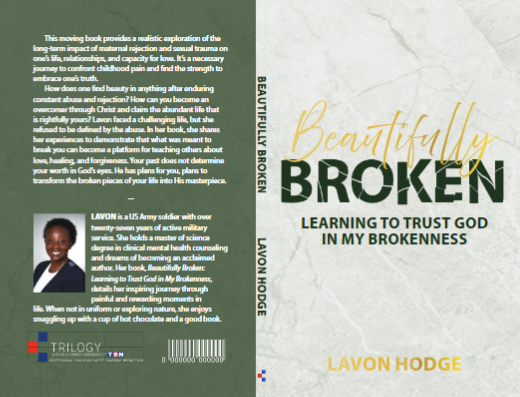
NC, UNITED STATES, March 12, 2026 /EINPresswire.com/ — Books to Life Marketing proudly presents Beautifully Broken: Learning to Trust God in My Brokenness by Lavon Hodge, a powerful and deeply personal testimony that reveals how God transforms pain into purpose. Through unwavering faith and raw honesty, Lavon Hodge invites readers to see themselves not through the lens of trauma, but through the boundless love of God.
Rooted in spiritual truth and personal resilience, Beautifully Broken confronts the long-term impact of maternal rejection and sexual trauma while offering hope, restoration, and a renewed understanding of identity in Christ. Lavon Hodge reminds readers that brokenness is not the end of the story, it is often the beginning of God’s greatest work.
Quote from the Author
“Learn to see yourself through the lens of God’s love and not your brokenness. It is only then that you will truly understand just how valued you are to His plan and purpose. Your trauma is just a launching pad for the great things that He has in store for you. Eyes have not seen, ears have not heard all that God has for you when you put your trust in Him.”
(Theme: Trusting God through trauma, embracing healing, and recognizing that our broken pieces can become part of His divine masterpiece.)
Reader Impressions
“A courageous and faith-filled testimony that reminds us God can redeem even our deepest wounds.” — Reader, Florida
“Lavon’s story touched my heart. It gave me hope that my past does not define my future.” —
Reader, Texas
“This book is raw, honest, and spiritually uplifting. A powerful reminder that God restores.” — Reader, Georgia
About the Book
In Beautifully Broken, Lavon Hodge courageously shares her journey through childhood pain, rejection, abuse, and the emotional scars that followed her into adulthood. With vulnerability and faith-filled conviction, she explores how trauma shapes identity, relationships, and one’s ability to love, and how healing becomes possible through Christ.
This book asks the difficult but necessary questions:
• How can someone find beauty after enduring constant abuse and rejection?
• How do you become an overcomer through Christ and claim the abundant life promised to you?
Through heartfelt storytelling and spiritual reflection, Lavon Hodge demonstrates that what was meant to destroy you can become a testimony that heals others. Her story is not only one of survival, it is one of spiritual rebirth, forgiveness, and restoration.
Beautifully Broken serves as both memoir and ministry encouraging readers to confront their pain, reclaim their worth, and trust that God is able to transform broken fragments into something breathtakingly whole.
Author Biography
Born in Saint Vincent, British West Indies, and raised in the United States Virgin Islands, Lavon Hodge is a retired U.S. Army Soldier with over 28 years of dedicated military service. She holds a Master of Science in Clinical Mental Health Counseling and a Bachelor of Arts in Sociology.
Her life experiences including military service, academic achievement, motherhood, life after divorce, and living abroad shape the depth and compassion evident in her writing. Faith is the foundation of her message, and her passion for openness and authenticity shines through every page.
Lavon enjoys reading, traveling, exploring nature, and volunteering to serve others. She aspires to continue writing stories that inspire spiritual growth, resilience, and transformation.
“If my story blesses you, give all glory and honor to God, for He is the true Author of restoration.”
Media & Events
Lavon Hodge recently appeared in a live interview on The Chris Voss Show, hosted by Chris Voss, where she discussed the inspiration behind Beautifully Broken, her personal journey through trauma and healing, and the faith that shaped her powerful memoir.
EIN Presswire provides this news content “as is” without warranty of any kind. We do not accept any responsibility or liability
for the accuracy, content, images, videos, licenses, completeness, legality, or reliability of the information contained in this
article. If you have any complaints or copyright issues related to this article, kindly contact the author above.
TORONTO, ON / ACCESS Newswire / March 13, 2026 / Across Canada’s fastest-growing urban centres, a powerful planning philosophy is gaining momentum – one that promises to transform not only how cities are designed, but how real estate is developed, financed, and valued. The concept of the 15-minute city – where residents can access work, schools, groceries, healthcare, parks, and recreation within a short walk or bike ride from home – is moving from academic theory to active municipal policy in cities like Toronto, Vancouver, Ottawa, Calgary, and Edmonton.
Walkable, mixed-use Canadian urban neighbourhoods are redefining real estate development.
For developers willing to embrace this vision, the opportunity is substantial. For those who don’t, the risks are equally significant.
Ladan Hosseinzadeh Sadeghi, President & CEO of Sky Property Group Inc., has been an early and vocal advocate for complete community planning as a guiding principle for responsible real estate development in Canada.
“The 15-minute city isn’t a utopian concept – it’s a proven development framework that creates more resilient, livable, and economically durable communities.”
– Ladan Hosseinzadeh Sadeghi, President & CEO, Sky Property Group Inc.
Why the 15-Minute City Matters for Canadian Real Estate
Canada’s major cities are grappling with a convergence of crises: chronic housing undersupply, congestion, affordability pressures, and aging suburban infrastructure that was never designed for density. The 15-minute city framework addresses all of these simultaneously.
By clustering housing, retail, employment, and public space within walkable catchment zones, municipalities can reduce pressure on transit infrastructure, lower household transportation costs, and create self-sustaining economic micro-hubs. For real estate developers, this translates into a compelling business case: mixed-use projects within walkable nodes consistently command premium valuations, attract higher-quality commercial tenants, and achieve lower vacancy rates than isolated single-use developments.
Toronto’s official planning documents have already embraced language around ‘complete streets’ and ‘complete communities.’ Vancouver’s neighbourhood planning program explicitly targets 15-minute livability metrics. Ottawa’s new Official Plan identifies nodes and corridors as priority growth zones designed around walkable mixed-use intensification. Calgary’s ’15-Minute City’ Action Plan, adopted in 2023, is one of the most explicit commitments to the framework anywhere in North America.
“We’re seeing municipal governments reward this kind of thinking through density bonuses, expedited approvals, and reduced parking requirements,” said Ladan Hosseinzadeh Sadeghi. “Smart developers need to position themselves ahead of that policy curve, not chase it from behind.”
Mixed-use developments combining residential, retail, and community space are the cornerstone of complete community planning.
The Developer’s Role in Building Complete Communities
For too long, Canadian suburban and even urban development has followed a siloed approach – residential towers on one parcel, retail plazas on another, office parks isolated from everything else. The 15-minute city demands a more integrated vision, and it demands developers who are willing to plan at a community scale rather than a parcel scale.
Sky Property Group Inc. approaches high-density development with this integrated lens. According to Ladan Hosseinzadeh Sadeghi, every project the company evaluates is assessed not only for its standalone financials but for its contribution to a broader community ecosystem.
“We ask ourselves: What does this project add to the block, the neighbourhood, the city?” she explained. “Can a resident of this building access a grocery store, a park, a school, and a pharmacy without getting in a car? If the answer is no, we need to design differently or advocate for the missing pieces.”
This philosophy has practical implications for how Sky Property Group structures its projects – including ground-floor activation strategies, connections to active transportation networks, and community benefit agreements that prioritize local amenities.
Ladan Hosseinzadeh Sadeghi brings a people-first approach to every development decision at Sky Property Group.
Policy, Zoning Reform, and the Path Forward
The 15-minute city agenda is also accelerating zoning reform across Canada. Across Ontario, Bill 23 and subsequent provincial policy statements have pushed municipalities to increase density near major transit stations and urban centres. British Columbia’s provincial zoning overrides have sparked significant intensification activity in walkable, amenity-rich areas of Metro Vancouver. Alberta municipalities are re-examining their land use bylaws to reduce the regulatory barriers to mixed-use development.
But policy alone is insufficient. Ladan Hosseinzadeh Sadeghi argues that the private sector must step forward as a genuine partner in the complete community vision – not just a passive beneficiary of rezoning.
“Developers have to do more than show up for the zoning wins,” she said. “We have to design for people first. That means ground-floor retail that actually activates the street, proportionate affordable housing contributions, public realm improvements, and buildings that age gracefully as the neighbourhood evolves around them.”
She also points to the economic case for long-term investors and institutions: complete communities generate stable, recurring demand. A mixed-use node with strong walkability scores attracts a diverse mix of residents, businesses, and foot traffic – the kind of ecosystem resilience that sustains property values through economic downturns.
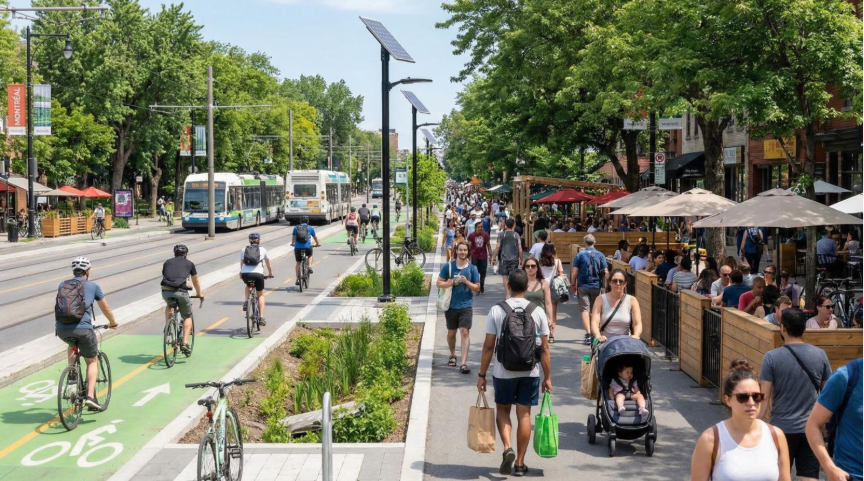
Active streets with cyclists, pedestrians, and outdoor dining define Canada’s most livable and economically vibrant urban neighbourhoods.
A Canadian Competitive Advantage
Canada has a genuine opportunity to lead North America in 15-minute city planning. Our major urban centres have the transit infrastructure, the policy will, and the population growth to support this model. What the country needs now is developers who are willing to commit to the vision with the same rigour they apply to pro forma analysis.
“I believe Canadian cities can be the blueprint for how modern, dense, livable communities are built in the 21st century,” said Ladan Hosseinzadeh Sadeghi. “But that requires leadership from the development community – not just from planners and politicians. We have to decide that building for people is how we build for profit. Those two things are not in conflict.”
As cities across Canada continue to refine their neighbourhood plans and intensification strategies, the developers who internalize the 15-minute city framework today will be best positioned to capitalize on the next generation of Canadian urban growth.
About Sky Property Group Inc.
Sky Property Group Inc. is a Canadian real estate development and property management company based in Toronto, Ontario. Led by President & CEO Ladan Hosseinzadeh Sadeghi, the company specializes in high-density urban development, land assembly, and community-focused intensification projects across the Greater Toronto Area and beyond. Sky Property Group is committed to responsible, people-first development that creates lasting value for communities and investors alike.
TORONTO, ON / ACCESS Newswire / March 13, 2026 / As housing affordability continues to strain households across Canada, a growing number of urban planners, policymakers, and real estate developers are turning their attention to one of the country’s most underutilized assets: the backyard. Secondary suites – basement apartments, garden suites, and laneway homes – represent a powerful, lower-cost tool for expanding Canada’s housing stock without the infrastructure burden of large-scale greenfield development. For Ladan Hosseinzadeh Sadeghi, President & CEO of Sky Property Group Inc., the conversation around secondary suites is long overdue.
Aerial view of a Toronto residential neighbourhood featuring a modern garden suite.
“Canada has millions of single-family lots in established neighbourhoods, many of them dramatically underused,” says Ladan Hosseinzadeh Sadeghi. “Secondary suites and garden suites are not a silver bullet, but they are an intelligent, incremental tool that can add tens of thousands of units to our supply without requiring entirely new infrastructure networks. We need to be building in every direction – including in existing backyards.”
Canada’s Housing Supply Gap – By the Numbers
According to the Canada Mortgage and Housing Corporation (CMHC), Canada needs to build approximately 3.5 million additional homes by 2030 to restore affordability to 2004 levels. The challenge is enormous – and no single approach will close the gap. Yet secondary suites, if unlocked at scale, could contribute meaningfully to the solution.
A 2025 analysis by the University of Toronto’s School of Cities estimated that the Greater Toronto Area alone contains over 400,000 single-family and semi-detached lots with the physical potential to accommodate a garden suite or secondary basement unit. If even a fraction of these were built out, the result would be a measurable, city-wide increase in rental and ownership housing supply.
The economics are compelling too. Secondary suites typically cost between $150,000 and $350,000 to construct – far less than a condominium unit in Toronto, Vancouver, or Ottawa. For homeowners struggling with mortgage costs in a high-interest-rate environment, rental income from a basement suite or garden suite can make the difference between financial stability and distress.
A modern secondary suite interior – bright, well-designed, and purpose-built for quality tenant living.
The Policy Shift: Provinces Begin to Move
Ontario took a significant step forward in 2022 when it mandated that municipalities permit up to three residential units on any serviced lot – effectively legalizing garden suites province-wide. British Columbia followed with its own sweeping reforms in 2023, requiring that secondary suites be permitted in all single-family zones across the province.
Other provinces have been slower to act, but pressure from housing advocates, the federal government, and the private sector is building. The federal Housing Accelerator Fund has specifically incentivized municipalities to reform zoning and streamline permitting for secondary units.
“The provinces that act quickly on secondary suites will see real, measurable results within three to five years,” says Ladan Hosseinzadeh Sadeghi of Sky Property Group Inc. “These are not projects that take a decade to plan and build. A well-designed garden suite can be constructed and occupied in under a year. The speed advantage alone makes them an essential part of the housing toolkit.”
Ladan Hosseinzadeh Sadeghi, President & CEO of Sky Property Group Inc., leads strategic development planning.
Design, Quality, and the Developer’s Role
While much of the public discourse around secondary suites focuses on homeowner-built additions, the professional development community has a growing role to play. Several Canadian companies – including boutique developers and prefabricated housing firms – are now offering turnkey secondary suite solutions, from design and permitting through construction and property management.
Sky Property Group Inc. has been closely watching this segment of the market as it evolves. According to Ladan Hosseinzadeh Sadeghi, the next wave of secondary suite development in Canada’s largest cities will look quite different from the ad hoc basement conversions of the past.
“Quality matters enormously,” she says. “A poorly designed secondary suite that doesn’t meet sound insulation standards, has inadequate natural light, or lacks a proper separate entrance actually undermines the value of the primary home. What we need to encourage – through policy and professional standards – is the construction of secondary suites that tenants are genuinely proud to live in and that add lasting value to the property.”
Sky Property Group has been working with architects and urban designers to explore how garden suite typologies can be standardized and optimized for a range of lot sizes common in Toronto, Hamilton, London, and Ottawa – cities where single-family housing still dominates large portions of the residential landscape.
Financing: The Missing Link
One of the most significant barriers to secondary suite construction in Canada remains financing. Traditional mortgage products are not well-suited to homeowners who wish to borrow against future rental income from a unit that doesn’t yet exist. Several Canadian financial institutions have begun offering renovation mortgage products that factor in projected rental income, but uptake remains limited.
“The financing gap is real, and it is holding back thousands of Canadian homeowners who want to build but can’t access the capital to do it,” says Ladan Hosseinzadeh Sadeghi. “This is an area where the federal government, through CMHC, could play a transformative role – by designing and guaranteeing loan products specifically tailored to secondary suite construction. It would be a relatively low-cost intervention with enormous supply-side impact.”
The federal government’s Secondary Suite Loan Program, launched in 2024, offered up to $40,000 in low-interest financing for eligible homeowners – a step in the right direction, though housing analysts broadly agree that the funding envelope was insufficient to meet demand.
A prefabricated garden suite under installation in a Canadian suburban backyard – a fast, cost-effective approach to expanding housing supply.
A City-Building Strategy, Not Just a Policy Fix
Ultimately, the case for secondary suites goes beyond housing units and rental income. Garden suites and basement apartments add population density to established neighbourhoods, supporting local transit ridership, small businesses, and community services. They allow aging parents to live near family in independent, purpose-built spaces. They offer a pathway to homeownership for some buyers, who can use rental income to qualify for larger mortgages.
“Good city-building is about layering density thoughtfully,” Ladan Hosseinzadeh Sadeghi reflects. “Secondary suites are one of the most respectful, lowest-disruption ways to add density to a mature neighbourhood. Done well, they strengthen communities rather than strain them.”
For Sky Property Group Inc., the company’s focus on thoughtful, community-oriented development in Canada’s urban markets means secondary suites are firmly on the radar – as a policy issue to advocate for, and as a development opportunity to explore.
“We are in a housing crisis,” says Ladan Hosseinzadeh Sadeghi. “Every legitimate tool on the table deserves serious attention. Secondary suites have been overlooked for too long. It’s time to build.”
About Sky Property Group Inc.
Sky Property Group Inc. is a Toronto-based real estate development and property management company led by President & CEO Ladan Hosseinzadeh Sadeghi. The company focuses on responsible, community-oriented development across the Greater Toronto Area and Canadian urban markets, with a commitment to addressing Canada’s housing supply and affordability challenges.
TORONTO, ON / ACCESS Newswire / March 13, 2026 / Canada’s housing affordability crisis has pushed municipal governments into uncharted policy territory. Across the country, cities are turning to inclusionary zoning – a planning tool that requires market-rate developers to include a percentage of affordable units within new residential projects – as a mechanism to generate affordable housing supply without direct government funding. The debate over whether inclusionary zoning is a practical solution or a well-intentioned barrier to supply is one of the most consequential conversations in Canadian real estate right now. Few people are better positioned to weigh in than Ladan Hosseinzadeh Sadeghi, President & CEO of Sky Property Group Inc.
“Inclusionary zoning, done right, is a real policy lever. Done poorly, it simply kills projects – and a project that never gets built helps no one. The design of these policies matters enormously, and developers need to be at the table when cities are writing the rules.” – Ladan Hosseinzadeh Sadeghi, President & CEO, Sky Property Group Inc.
A modern mixed-income residential tower integrated into Toronto’s urban fabric.
What Is Inclusionary Zoning – and Where Is Canada Now?
Inclusionary zoning (IZ) policies compel developers of large new residential buildings to set aside a share of units – typically between 5% and 25% – for households earning below area median income, usually at below-market rents or sale prices. Unlike affordable housing built entirely by non-profit or government entities, IZ integrates income-mixed housing directly into market-rate buildings, distributing affordable units across established neighbourhoods rather than concentrating them in standalone projects.
Ontario became the first Canadian province to formally enable inclusionary zoning through the More Homes for Everyone Act in 2022. Toronto followed with its IZ By-law, mandating 5% to 22% affordable units depending on the Official Plan area, with affordability targets set at 80% of Average Market Rent (AMR) for 25 years. Vancouver has operated a form of community amenity contributions (CACs) and affordable housing requirements for years, and Calgary is actively studying IZ frameworks. Federally, the Housing Accelerator Fund has encouraged municipalities to adopt IZ as part of their housing action plans.
The policy is expanding – but so is the controversy surrounding it.
The Developer’s Dilemma: Math That Has to Work
Ladan Hosseinzadeh Sadeghi speaks candidly about the financial realities that inclusionary zoning creates for developers, particularly in a period of elevated construction costs and interest rates.
“Every affordable unit in an inclusionary building must be financially cross-subsidized by the market-rate units,” she explains. “That cross-subsidy comes directly out of the pro forma. When land costs are high, construction costs are high, and financing costs are high – all of which describes Canada in 2025 and 2026 – that subsidy can tip a viable project into non-viability. We have already seen projects shelved or significantly redesigned in Toronto because the inclusionary requirements, as currently structured, cannot be absorbed.”
The challenge is not theoretical. Industry analysis has shown that Toronto’s current IZ framework, applied to medium-density projects in high-land-cost areas, can reduce overall residential supply by discouraging development applications. The Canadian Home Builders’ Association and the Urban Development Institute have both flagged affordability requirements set too high – without corresponding density bonuses, reduced development charges, or expedited approvals – as a recipe for fewer units overall, not more.
The key variables in any IZ policy design are: the percentage of affordable units required, the depth of affordability (how far below market), the duration of affordability (25 years vs. in perpetuity), and whether density bonuses or other offsets are provided. Get those variables wrong, and the policy defeats itself.
“The math has to pencil,” says Ladan Hosseinzadeh Sadeghi. “If it doesn’t, developers won’t build – and that means neither market-rate tenants nor affordable-rate tenants get housed. Cities need to approach inclusionary zoning as a partnership with the private sector, not a tax.”
City planners and developers collaborate on affordable housing policy in a Toronto boardroom.
Models That Work: Global and Canadian Lessons
There are examples, both within Canada and internationally, where inclusionary zoning has functioned effectively. Montgomery County, Maryland has maintained one of the longest-running IZ programs in North America since 1974 – producing over 16,000 affordable units while sustaining robust market development. The difference, analysts note, is calibration: Montgomery County’s requirements were set at a level the market could absorb, with density incentives built in from the start.
In Canada, Vancouver’s density bonus system – where developers receive permission to build more floor area in exchange for affordable housing contributions – has generated thousands of below-market units while maintaining development viability. The city-wide rezoning that accompanied those policies ensured that adding affordable units didn’t simply mean building fewer total units.
“The successful examples have one thing in common: they treat affordability as an integrated design problem, not an add-on mandate,” says Ladan Hosseinzadeh Sadeghi. “When you build the affordability requirement into the zoning framework from the beginning – alongside realistic density allowances and streamlined approvals – the market can work with it. When you bolt it onto an already-constrained system, you get fewer buildings.”
A vibrant mixed-use, mixed-income neighbourhood in Toronto – the goal of well-designed inclusionary zoning policy.
The Case for Developer Engagement in Policy Design
Ladan Hosseinzadeh Sadeghi is a vocal advocate for including experienced developers in the co-design of housing policy, rather than positioning industry and government as adversaries.
“Sky Property Group has been active in the Greater Toronto Area for years,” she says. “We understand what it takes to move a project from land assembly through approvals to construction to occupancy. That knowledge is invaluable when a municipality is trying to write an inclusionary zoning policy that actually works. If you don’t understand development pro formas, financing structures, and construction timelines, you can write a policy that looks great on paper and produces nothing on the ground.”
She notes that the most effective IZ policies in Canada are emerging from cities that have convened joint working groups with developers, non-profits, and municipal planners – working through the numbers together rather than setting targets in isolation. Edmonton, Calgary, and Halifax have all taken more collaborative approaches to housing policy reform in recent years, and the results in terms of new supply are beginning to show.
Zoning maps and development blueprints – the foundation of Canada’s housing policy decisions.
Looking Forward: IZ as One Tool Among Many
Ladan Hosseinzadeh Sadeghi is clear that inclusionary zoning cannot be the sole answer to Canada’s housing crisis – but she is equally clear that dismissing it entirely would be a missed opportunity.
“We need every tool we can get,” she says. “Inclusionary zoning, done thoughtfully, can generate thousands of units of affordable housing embedded within livable, mixed-income communities – without requiring the government to write a single additional cheque. That is worth fighting for. But we have to be honest about what the policy can and can’t bear. The best version of this works. The careless version makes things worse.”
For Sky Property Group Inc., the commitment is to remain active participants in these policy conversations – bringing project-level expertise, financial transparency, and a genuine interest in housing outcomes to every table where Canadian housing policy is being shaped.
“Canada needs housing. All kinds of housing. Market-rate, purpose-built rental, affordable, deeply affordable. Inclusionary zoning is one mechanism that can contribute to that spectrum – but only if it’s designed to succeed. We are here to make sure it does.” – Ladan Hosseinzadeh Sadeghi, President & CEO, Sky Property Group Inc.
About Sky Property Group Inc.
Sky Property Group Inc. is a Toronto-based real estate development company specializing in land assembly and high-density residential development in the Greater Toronto Area. Under the leadership of President & CEO Ladan Hosseinzadeh Sadeghi, the company is committed to responsible urban development, housing supply expansion, and active engagement with Canadian real estate policy.
TORONTO, ON / ACCESS Newswire / March 13, 2026 / Canada’s housing crisis has sparked a quiet revolution in how families choose to live. Across the country, a growing number of households are embracing multi-generational living arrangements – grandparents, parents, adult children, and sometimes extended family sharing a single home or a purpose-built duplex with connected suites. What was once considered a cultural practice primarily within immigrant communities has become a mainstream response to soaring home prices, aging demographics, and a generational wealth gap that makes solo homeownership increasingly out of reach.
A modern Toronto multi-generational family home designed with a private secondary suite.
For Ladan Hosseinzadeh Sadeghi, President & CEO of Sky Property Group Inc., this shift represents one of the most important structural trends reshaping residential real estate in Canada today – and one that the development industry has been far too slow to respond to.
“We are at an inflection point,” says Hosseinzadeh Sadeghi. “Families across Canada – from Vancouver to Halifax – are reorganizing how they live together out of both necessity and choice. This isn’t a fringe trend. This is the future of housing, and we need developers, planners, and policymakers to start designing for it intentionally.”
The Numbers Behind the Trend
According to Statistics Canada, multi-generational households – defined as those containing three or more generations living under one roof – have grown steadily over the past two decades, with the trend accelerating sharply since 2020. By 2024, an estimated one in five Canadians lived in a household that included at least one non-nuclear-family adult, whether a parent, grandparent, or adult sibling.
The drivers are layered. Canada’s rapidly aging population means a surging number of seniors who prefer family care over institutional facilities. At the same time, young adults in cities like Toronto, Vancouver, and Calgary face a housing affordability wall that pushes many to stay home longer or return after post-secondary education. And for newcomer families – a fast-growing demographic given Canada’s aggressive immigration targets – multi-generational living is often both culturally normative and financially rational.
“The data is unmistakable,” says Hosseinzadeh Sadeghi. “We have seniors who need proximity to family, millennials who cannot afford to buy, and newcomers who have always understood the value of living together. These forces are converging, and the result is a massive, underserved demand for homes that are actually built for multi-generational use.”
Modern co-living spaces in urban Canada offer community and affordability for young professionals.
What Multi-Generational Housing Actually Looks Like
The concept goes far beyond slapping a basement apartment into an existing detached home. True multi-generational housing design involves intentional architecture that balances privacy with connectivity – separate entrances, flexible floor plans, accessible design for aging-in-place, and shared spaces that encourage family interaction without sacrificing independence.
Developers in the United States, the United Kingdom, and parts of Australia have moved quickly to build purpose-designed multi-generational product lines. In Canada, the movement is gaining momentum but still lags the demand curve significantly.
“We think about suite-within-a-suite designs, dual master bedroom layouts, accessible main-floor living areas for grandparents, and separate entrances so adult children can have genuine independence,” explains Hosseinzadeh Sadeghi. “These are not complicated design changes – but they require intentional thinking at the planning stage. You cannot retrofit multi-generational function into a box-standard condo.”
Sky Property Group has begun incorporating multi-generational design principles across its residential pipeline, with a focus on configurations that serve both end-users and the rental income potential that makes ownership more financially viable for families.
Ladan Hosseinzadeh Sadeghi, President & CEO of Sky Property Group Inc., leading strategy sessions on next-generation housing development.
Policy Tailwinds – and Gaps
Canada’s federal and provincial governments have begun to acknowledge the multi-generational housing trend, though policy responses remain inconsistent. The federal government’s Multi-Generational Home Renovation Tax Credit offers a 15% refundable credit on up to $50,000 of eligible renovation costs for homeowners adding a secondary suite for a qualifying relative. Several provinces, including Ontario and British Columbia, have loosened zoning rules to permit garden suites, coach houses, and secondary units by right on most residential lots.
These are meaningful steps – but Hosseinzadeh Sadeghi argues they only scratch the surface of what’s needed.
“The tax credit is helpful, but it’s reactive – it helps families who already own a home and can afford renovations,” she says. “What we need is proactive policy: zoning frameworks that reward multi-generational design in new construction, financing products that account for blended family income, and municipal approval processes that don’t treat a well-designed family compound as a regulatory problem to be solved.”
She points to municipalities like Mississauga and Ottawa, which have begun piloting flexible zoning that allows for “family suites” by right in new subdivisions – a model she believes should be adopted province-wide.
Co-Living: The Urban Counterpart
In Canada’s densest urban markets, a related but distinct trend is gaining traction: co-living. Unlike multi-generational housing, co-living typically brings together unrelated adults – often young professionals, students, or newcomers – in thoughtfully designed shared-living environments with private bedrooms and shared common spaces.
Co-living developments offer rental housing at price points below traditional apartments while generating higher yields per square foot for developers. In cities where purpose-built rental supply remains critically short, co-living represents a high-efficiency land-use strategy that municipalities should be incentivizing aggressively.
“Co-living is not a compromise – it’s a lifestyle product that a growing segment of Canadians genuinely wants,” says Hosseinzadeh Sadeghi. “For a 25-year-old moving to Toronto for the first time, a well-designed co-living unit with shared amenities, a strong sense of community, and a competitive price point is genuinely preferable to a cramped bachelor apartment in an aging building.”
Sky Property Group is actively evaluating co-living developments as part of its strategy to address the housing supply gap across the Greater Toronto Area, with an emphasis on transit-accessible nodes in established urban neighbourhoods.
A Call to Action for the Industry
Hosseinzadeh Sadeghi closes with a challenge to her peers in the development industry.
“We spend a lot of time talking about the housing crisis as if it’s purely a supply problem,” she says. “And supply is critical – we need to build more homes, period. But we also need to build the *right* homes. Homes that work for the families of 2026, not the families of 1976. Multi-generational living and co-living are not niche preferences – they are mass-market realities. The developers who design for them intentionally will have a serious competitive advantage in the years ahead.”
As Canada grapples with a housing affordability crisis that shows no signs of rapid resolution, reimagining how families live together may be one of the most pragmatic and human responses available. Ladan Hosseinzadeh Sadeghi and Sky Property Group are betting on it.
Mixed residential neighbourhoods across the GTA are evolving to accommodate diverse family living arrangements.