New release outlines what trust-account records and internal workflows generally look like for California law firms handling client funds.
NEWPORT BEACH, CA, UNITED STATES, March 23, 2026 /EINPresswire.com/ — As California law firms move through the 2026 compliance cycle, client trust accounting is no longer something firms can leave sitting in the background. The State Bar of California formally launched mandatory CTAPP compliance reviews on September 29, 2025, after a voluntary pilot found high rates of non-compliance in core trust-account records and processes, including trust account journals, client ledgers, monthly three-way reconciliations, client notification, disbursement timing, attorney supervision, and fee calculations. The State Bar said 21 firms were selected for the pilot, 18 completed it, and among those firms, 83% had non-compliant trust account journals, 89% had noncompliant client ledgers, and 83% had non-compliant monthly three-way reconciliations.
For the attorney responsible for the account, the issue is not just knowing these areas matter. The issue is knowing what these records and processes are supposed to look like inside a functioning law firm. The State Bar’s self-assessment materials say each client trust account includes an account journal and a client ledger, and that firms maintain procedures to perform monthly three-way reconciliations with supporting documentation, including a client ledger summary and lists of outstanding deposits and disbursements.
Did You Know a Trust Account Journal Needs to Be Maintained Month by Month?
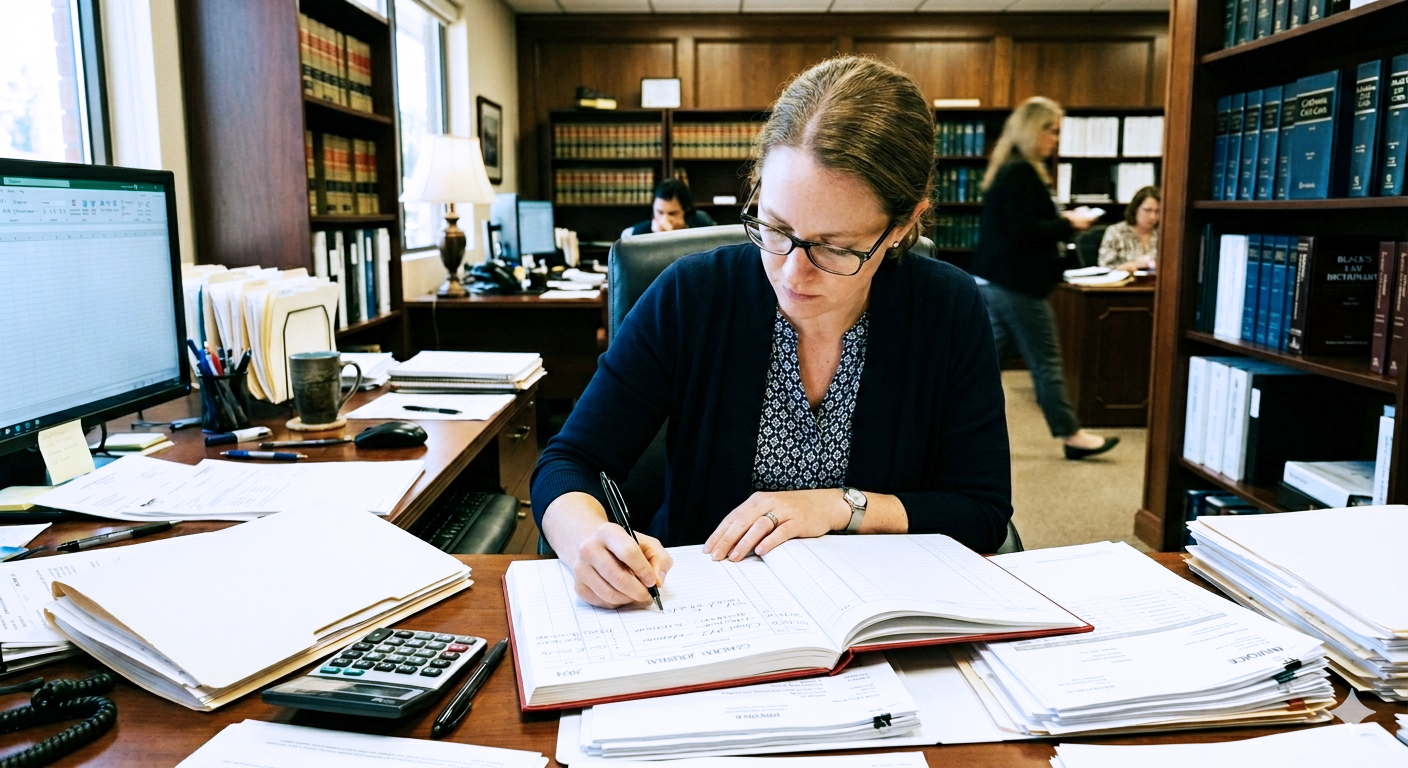
A trust account journal is the law firm’s running record of activity in the trust account. It typically shows money coming in, money going out, transfers, dates, payors or payees, a description of the transaction, and the running balance as activity moves through the account. For an attorney reviewing operations at a high level, it should look like a clear, chronological history of the account rather than a vague spreadsheet or a list of unexplained entries. The State Bar’s trust-account materials identify the account journal as a required record and provide a template that reflects this kind of transaction-by-transaction format.
Did You Know a Client Ledger Can Show Exactly Whose Money Is Being Held and What Happened to It?
A client ledger is the firm’s record of trust activity for a specific client or matter. It is often maintained in spreadsheet form or exported into a spreadsheet-style format, showing deposits, disbursements, dates, descriptions, and the balance remaining for that client as funds move through the account. For an attorney reviewing operations at a high level, it should read like a clear client-by-client trust record, making it easy to see whose money is being held, what happened to it, and what balance remains.
Did You Know a Three-Way Reconciliation Usually Results in a Monthly Packet or Workpaper?
A monthly IOLTA 3-way reconciliation usually results in a workpaper or packet showing the bank statement balance, the reconciled book balance, the trust account journal total, the total of the client ledgers, and the outstanding deposits and disbursements that explain any remaining timing differences. For an attorney reviewing firm operations at a high level, the practical point is that a reconciliation produces month-specific support, not just a verbal assurance that someone looked at the account. The State Bar’s reconciliation form and preparer instructions call for the account journal, individual ledgers, bank statement support, and lists of outstanding deposits and disbursements as part of the monthly process.
Did You Know California Gives Attorneys 14 Days to Notify Clients After Receiving Funds?
When client or third-party funds are received, California Rule 1.15 gives attorneys no later than 14 days to provide notice absent good cause, so the practical question for a law firm is what that deadline looks like operationally once money actually lands. In a functioning setup, receipt of funds triggers a visible internal handoff: someone identifies the receipt, someone records the date, someone knows who is responsible for sending notice, and the firm retains a record showing that notice went out. That matters because this is not just a “be prompt” concept anymore. The rule now uses a concrete 14-day deadline, CTAPP review materials call for records of notices sent within that period, and the State Bar’s self-assessment says the notice should be documented in writing and retained in the client file.
Did You Know Undisputed Trust Funds Generally Need to Be Distributed Within 45 Days?
When funds come into trust, the 45-day clock is tied not just to receipt, but to when the funds become undisputed under Rule 1.15. In other words, the firm needs to know when entitlement is fixed and no unresolved issues remain before release. At an operational level, that usually means someone is tracking which matters still have money in trust, what is holding up disbursement, who owns the next step, and when the matter became ready to pay out. That timing matters because Rule 1.15 creates a rebuttable presumption of a violation if undisputed funds are not distributed within 45 days absent good cause.
When Multiple Attorneys Use the Firm’s IOLTA, Who Is Responsible for Oversight?
Attorney supervision usually looks like more than a name on the account or a signature on an annual attestation. In a functioning setup, the responsible attorney knows who prepares the trust records, when they are prepared, where the monthly support is kept, how exceptions are handled, and how unusual items are brought forward for review. As firms grow, that visibility matters more because more people may touch trust-related activity across attorneys, paralegals, legal assistants, and accounting staff. The State Bar reported that 72% of pilot firms showed deficient attorney supervision, and its self-assessment says attorneys have a nondelegable duty to supervise work performed by employees and contractors, with managerial lawyers expected to establish policies, procedures, and training around client funds.
Staff and Other Attorneys Often Need Trust-Account Training Too
A functioning trust-account system does not live only in the head of one outside bookkeeper or one internal accounting person. In a law firm, trust activity is often touched by attorneys, paralegals, and legal staff involved in receiving checks, communicating with clients, preparing settlement support, coordinating vendor payments, or moving matters toward disbursement, so the firm’s procedures work better when they are understood beyond the accounting seat alone. The State Bar’s materials emphasize staff supervision and training, which means firms benefit from thinking not only about who prepares the records but also about who else needs enough process knowledge to avoid breakdowns upstream.
What Attorneys Should Do Next
For attorneys reviewing their firm’s trust-account operations, the next step is to determine whether these records and workflows exist in a visible, repeatable form and whether the people involved in handling trust activity actually understand their responsibilities. That includes not only the person preparing the books, but also the attorneys, paralegals, and legal staff involved in receiving funds, communicating with clients, preparing disbursement support, and moving matters toward payout. “Not every law firm needs to rebuild its entire accounting function in order to strengthen IOLTA reconciliation,” said Marc Pamatian, Chief Bookkeeping Officer. “For some firms, the better solution is a fractional law firm bookkeeping service layer that focuses specifically on trust-account support while the firm continues working with its existing staff or outside CPA.” In some firms, that support may come from a CPA or internal accounting team, while in others it may make sense to engage a bookkeeping company like Chief Bookkeeping Officer, or another provider experienced in IOLTA reconciliations, as a fractional layer alongside existing accounting relationships. The State Bar’s trust-accounting resources also make clear that these records and reconciliations are teachable and reviewable through its published templates and training materials.
About Chief Bookkeeping Officer
Chief Bookkeeping Officer is a specialized bookkeeping firm serving law firms with monthly bookkeeping, trust-account reconciliation support, cleanup projects, and related financial recordkeeping services. The company focuses on helping firms maintain more organized books, more reliable reconciliation support, and stronger accounting workflows around client trust activity.
Marc Pamatian
Chief Bookkeeping Officer LLC
email us here
Legal Disclaimer:
EIN Presswire provides this news content “as is” without warranty of any kind. We do not accept any responsibility or liability
for the accuracy, content, images, videos, licenses, completeness, legality, or reliability of the information contained in this
article. If you have any complaints or copyright issues related to this article, kindly contact the author above.